
Tips / X-Chain
Advanced
X-Chain
Prerequisite: Chain basics
1. Overview
X-Chain is a chain technique that focuses on one digit d.
Think of it as: connect candidate positions of the same digit d using strong links and weak links, to form a “if…then…” reasoning path.
Its most common use is elimination:
- the two endpoints are the same digit d
- if a candidate d can see both endpoints
⇒ that candidate d can often be eliminated
2. Walkthrough
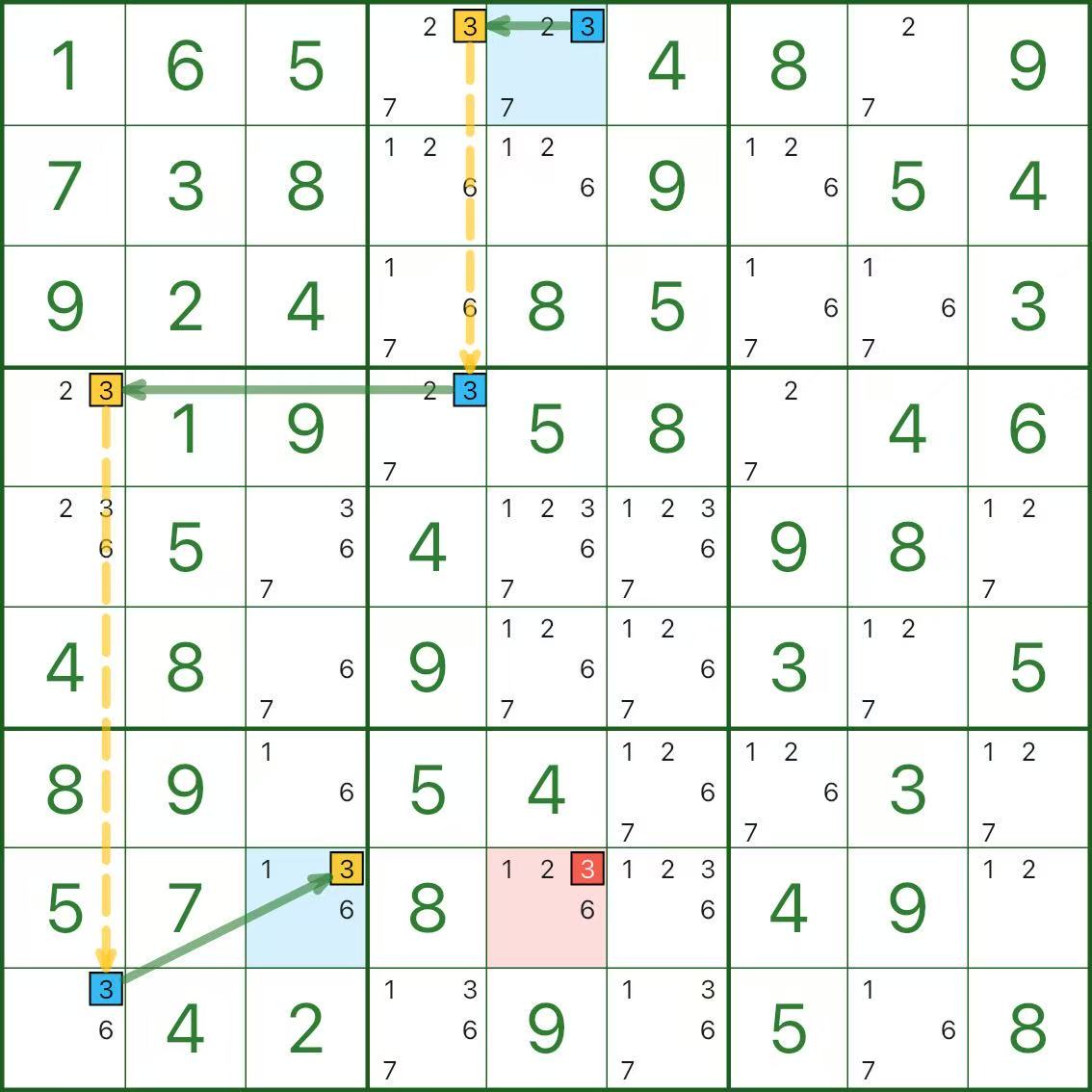
In the image, we only talk about candidate digit 3.
Starting from the blue endpoint r1c5, the chain alternates strong/weak links and eventually reaches the other blue endpoint r8c3.
The red candidate 3 in r8c5 is what we want to eliminate.
Why can we remove 3 in r8c5? A short contradiction is enough:
- Assume the red candidate r8c5 = 3 is true
- Then in the same column, r1c5 cannot be 3 (the start becomes “false”)
- Because the chain alternates strong/weak links:
- “false” goes through a strong link to force “true”
- “true” goes through a weak link to force “false”
step by step, the chain eventually forces r8c3 = 3 (the end becomes “true”)
- But r8c3 and r8c5 are in the same row: they cannot both be 3 — contradiction
So the assumption is impossible: 3 in r8c5 can be eliminated.
3. Examples
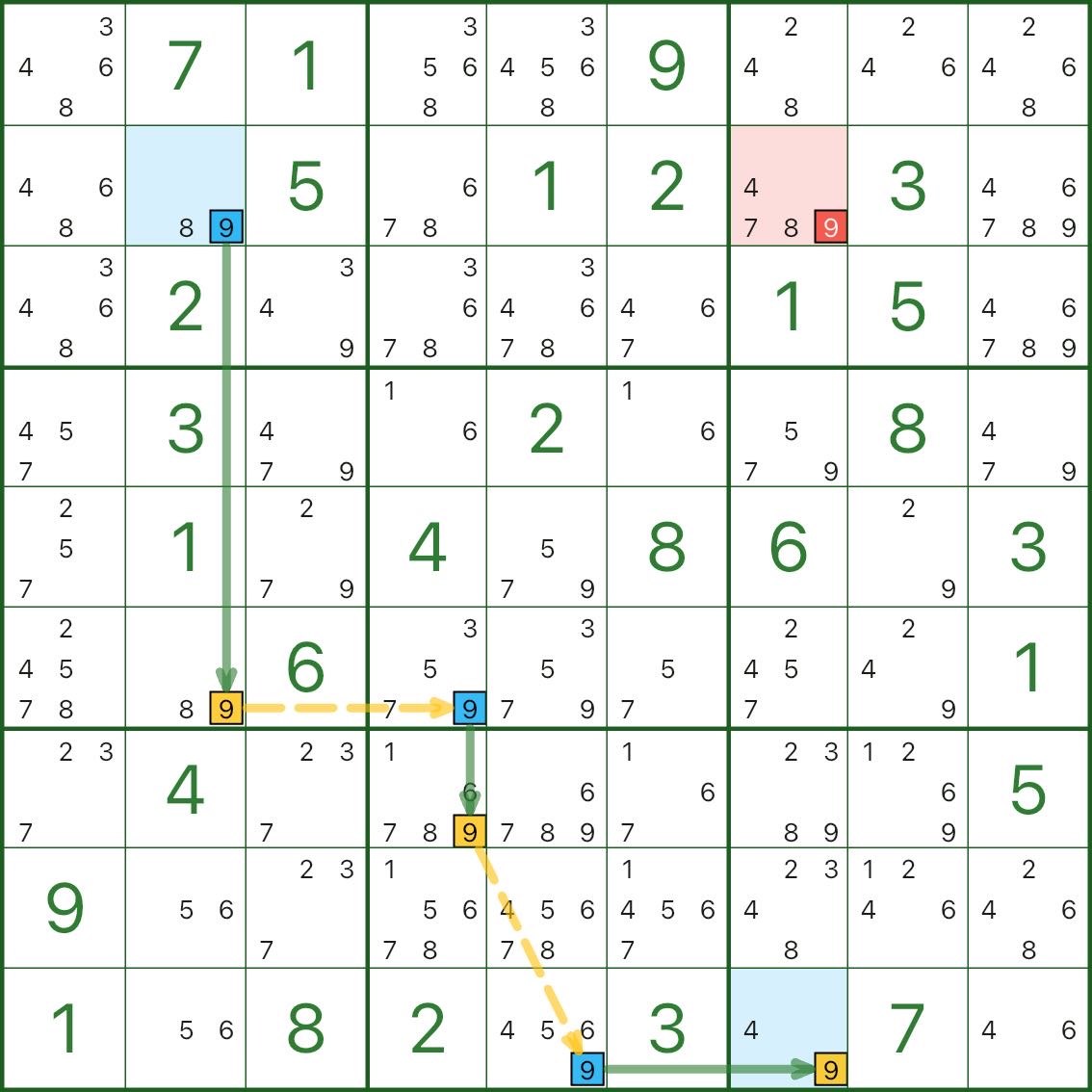
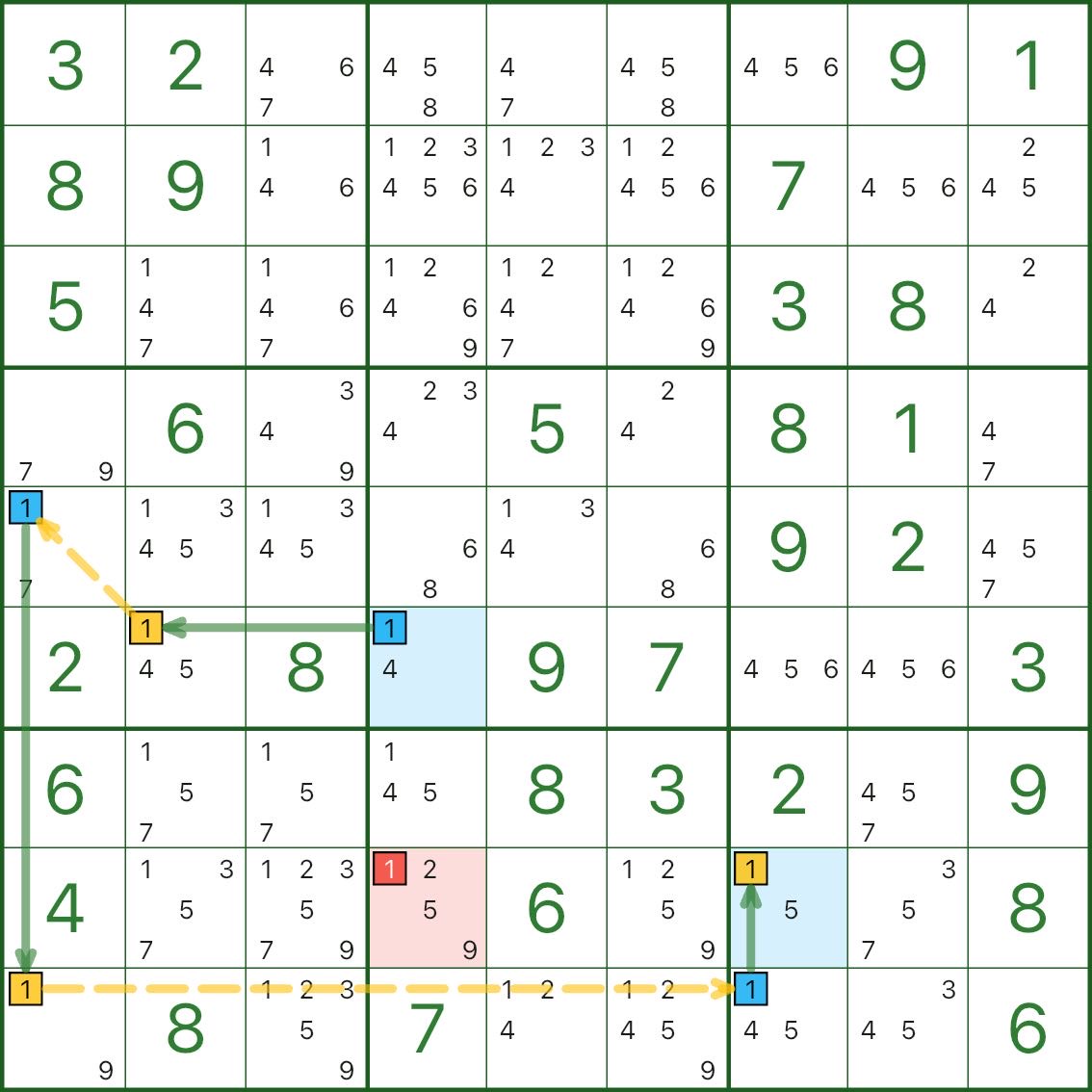
Here are two more X-Chain examples. You don’t need to verify every step at first — train your “pattern eye”:
- focus on one digit d
- find an alternating strong/weak chain connecting two endpoints
- find a red candidate d that can see both endpoints
4. How to spot X-Chain
In one sentence: pick a digit d, build an alternating chain using conjugate pairs (strong links), then eliminate d from any cell that can see both endpoints.
Practical checklist:
- Pick a digit d (for example 3)
- In rows/columns/boxes, find places where d has exactly two candidate positions (that’s a strong link)
- Connect these segments using “can see each other” relations (weak links) to form an alternating chain
- Find a candidate d that can see both endpoints — that’s a typical elimination