
Tips / Nishio Forcing Chain
Advanced
Nishio Forcing Chain
Prerequisite: Chain Basics
Overview
Nishio Forcing Chain is a proof-by-contradiction elimination technique.
When a candidate looks “suspicious” but you can’t remove it with a direct technique, you can do this:
- pick a candidate to test (red)
- assume it is true
- propagate forced truth/falsehood (blue = forced true, yellow = forced false)
- if you reach a contradiction (for example, a row has no place for a digit)
⇒ the assumption is impossible
⇒ eliminate the starting candidate
Walkthrough
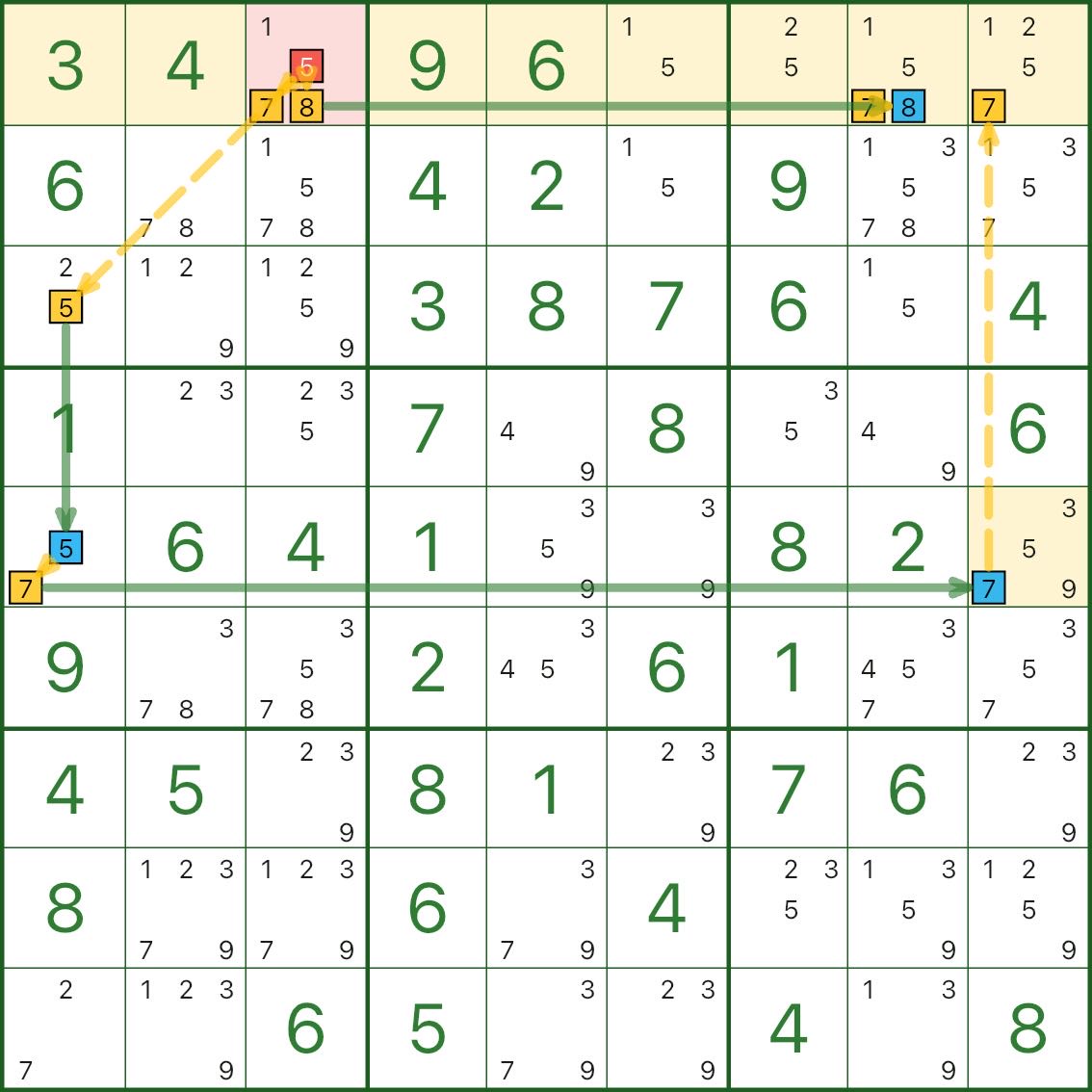
In the image above, the red elimination target is candidate 5 in r1c3.
We start a contradiction proof by assuming r1c3 = 5 is true.
Then we follow the forcing chain:
- blue candidates are forced true under this assumption
- yellow candidates are forced false under this assumption
You don’t need to verify every hop at first — focus on the contradiction:
In this example, the chain eventually eliminates every candidate 7 in row 1, meaning row 1 has no place for digit 7.
But every row must contain digits 1–9, so this is a contradiction.
Therefore the assumption r1c3 = 5 cannot be true, and candidate 5 in r1c3 can be eliminated.
Examples
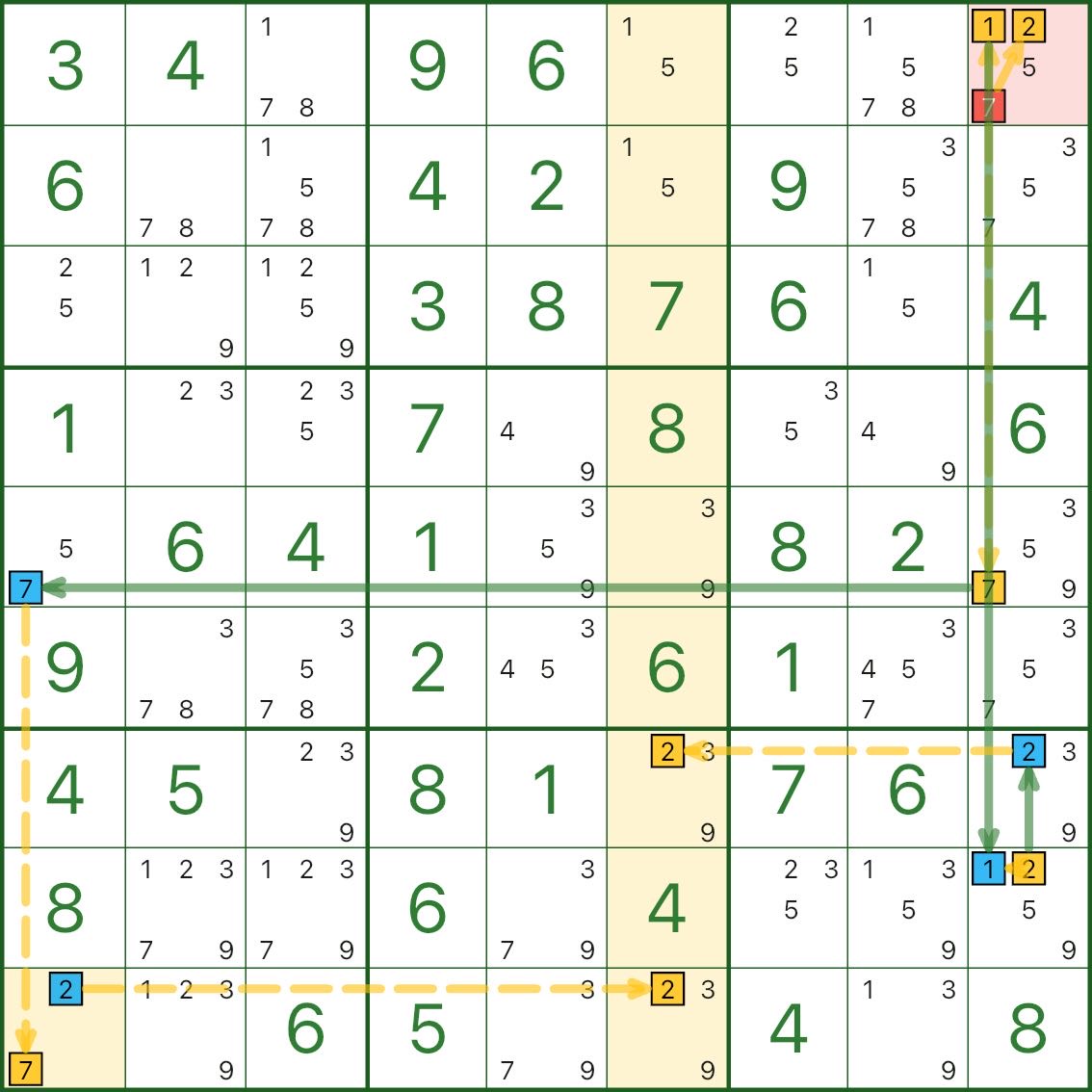
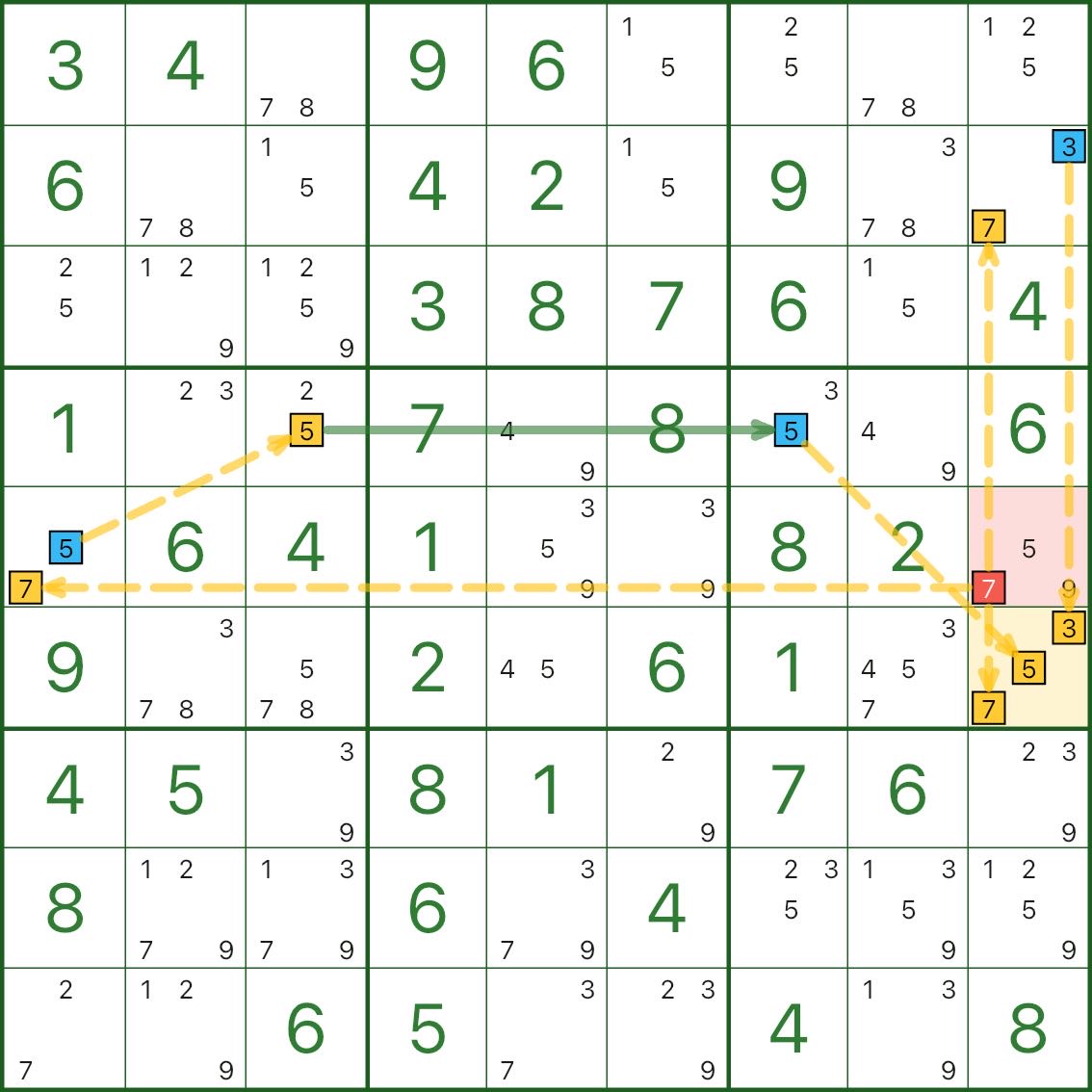
Here are two more Nishio examples. Try to follow this viewing order: red start (assume true) → blue/yellow propagation → contradiction → eliminate red.
How to Spot Nishio
One-line checklist: when stuck, pick a key candidate and test it by contradiction; if it quickly forces a contradiction, eliminate it.
Practical checklist:
- Prefer “high-impact” candidates: bivalue cells or candidates near conjugate pairs
- Assume it is true, then only apply deterministic propagation
- If you reach a contradiction (empty cell / no place for a digit in a house), eliminate the starting candidate