
Tips / Crane
Advanced
Crane
Prerequisite: Chain Basics
Description
Crane is a short single-digit candidate elimination technique: focus on one digit d.
It looks a lot like a Kite, but with a key difference:
- Kite: the “box connection” is a weak link
- Crane: one of the strong links is inside a box (a box strong link)
Explanation
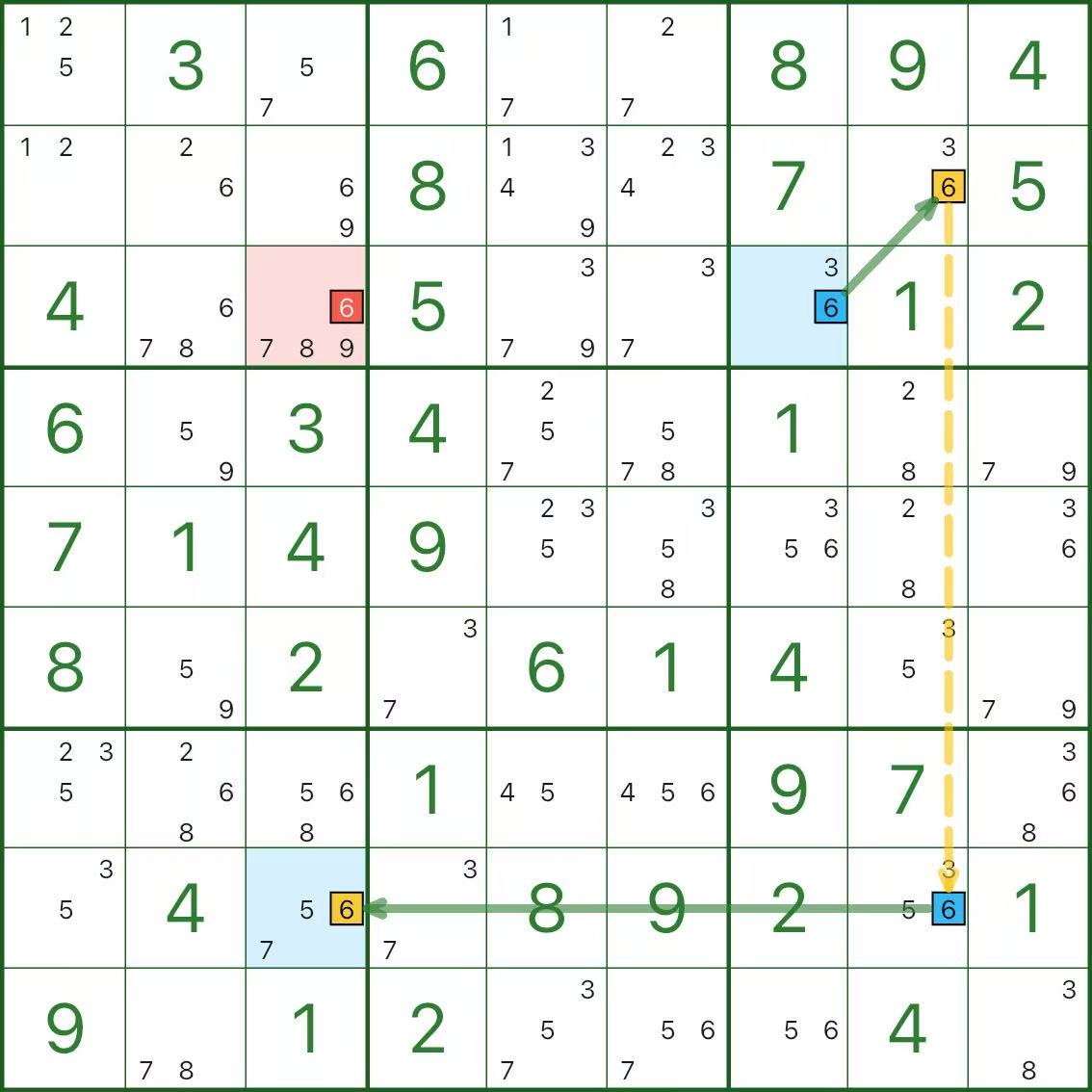
In the image above, the target digit is 6.
The chain is r3c7 → r2c8 → r8c8 → r8c3. The red candidate is digit 6 in r3c3, and the two endpoints are highlighted in blue.
Why can we eliminate it? A short contradiction is enough:
- Assume r3c3 = 6 (the red candidate is true)
- Then in row 3, r3c7 ≠ 6
- In that box, digit 6 has exactly two candidates (r3c7 and r2c8), so if r3c7 is not 6, r2c8 must be 6 (box strong link)
- If r2c8 is 6, then in the same column, r8c8 ≠ 6 (weak link)
- On row 8, digit 6 has exactly two candidates (r8c8 and r8c3), so if r8c8 is not 6, r8c3 must be 6 (row strong link)
- But r8c3 and r3c3 are in the same column, so they can’t both be 6 → contradiction
Therefore, r3c3 cannot be 6, and the red candidate can be eliminated.
Examples
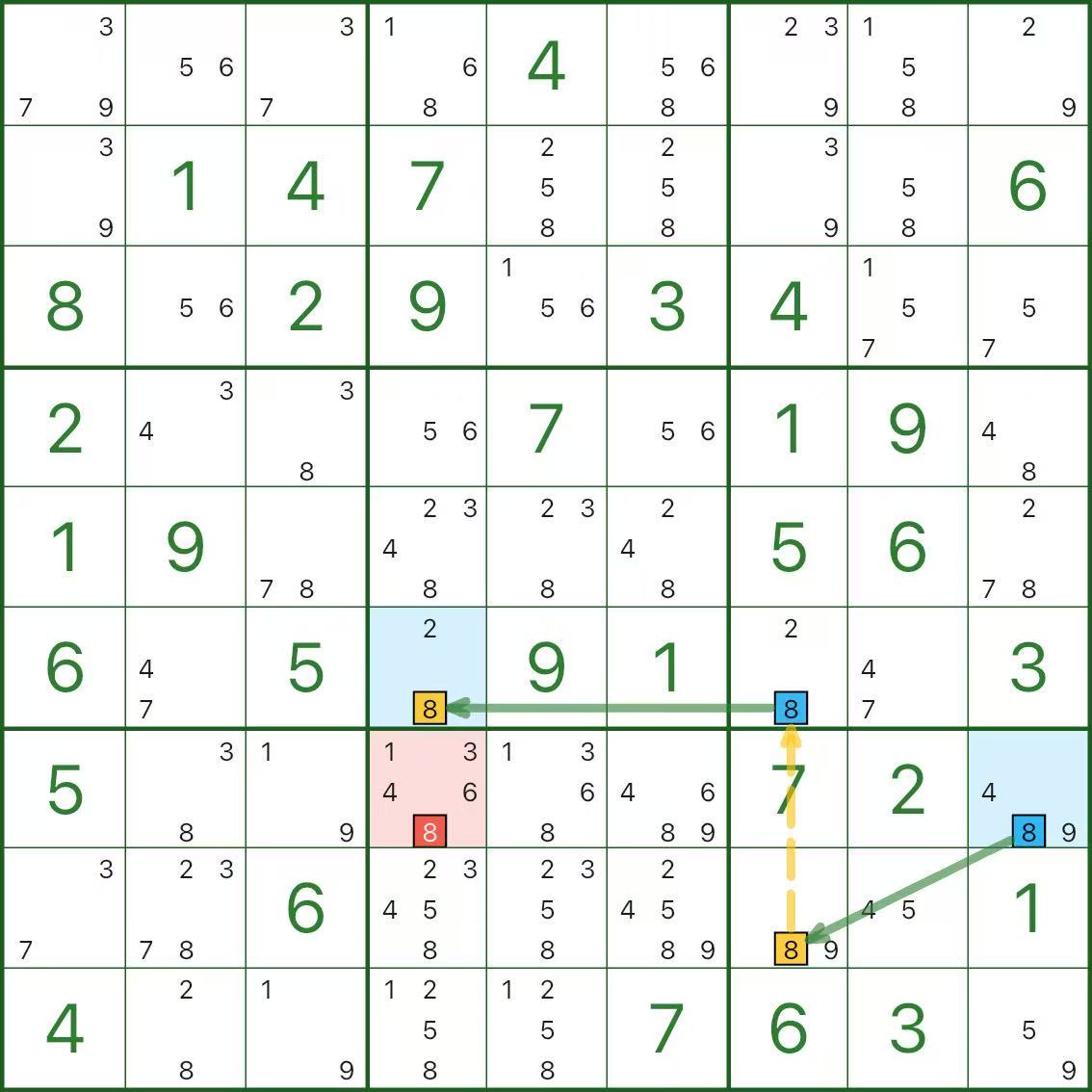
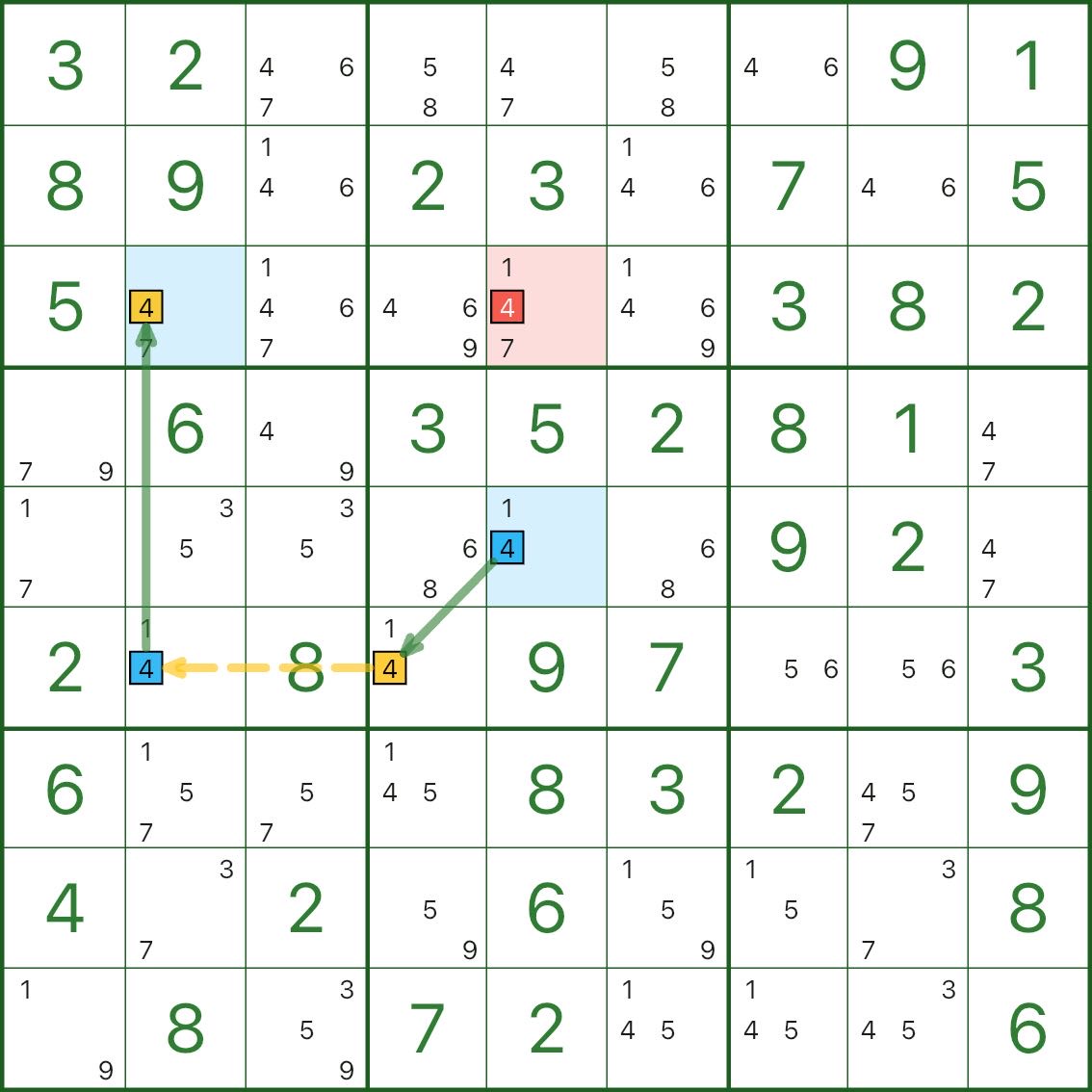
The next two images are more crane examples. Use them as references:
How to Find a Crane
One-line checklist: box strong link + row/column strong link, connected by a single weak link in an L-shape → eliminate where both endpoints are seen.
In a real puzzle:
- Pick a digit d
- Find a box where d appears in exactly 2 candidate cells (box strong link)
- Find a row or column where d also appears in exactly 2 candidate cells (row/column strong link)
- Check whether you can connect them with a single weak link (same row or same column) to form an L-shape
- The remaining two endpoints are the endpoints: eliminate d from any cell that can see both endpoints