
Tips / Basic Coloring
Advanced
Basic Coloring
Prerequisite: Chain Basics
Description
Basic coloring is a single-digit candidate elimination technique: focus on one digit d, and only use strong links from bilocations (a row/column/box where digit d appears in exactly two candidate cells).
You “color” the candidates along strong links using two colors (blue / yellow).
These two colors represent two mutually exclusive deduction routes: on a strong link, exactly one end is true, so the color alternates.
In one colored chain, you can think of blue/yellow as two opposite assumptions:
- Assume blue is true ⇒ yellow is false
- Assume blue is false ⇒ yellow is true
So in the same strong link, one of the two colors must be true.
Basic coloring usually leads to two kinds of conclusions:
- Trap: a red candidate can see one blue and one yellow candidate → the red candidate can be eliminated
- Same-color contradiction: two candidates of the same color appear in one house → that entire color is impossible and can be eliminated
Trap
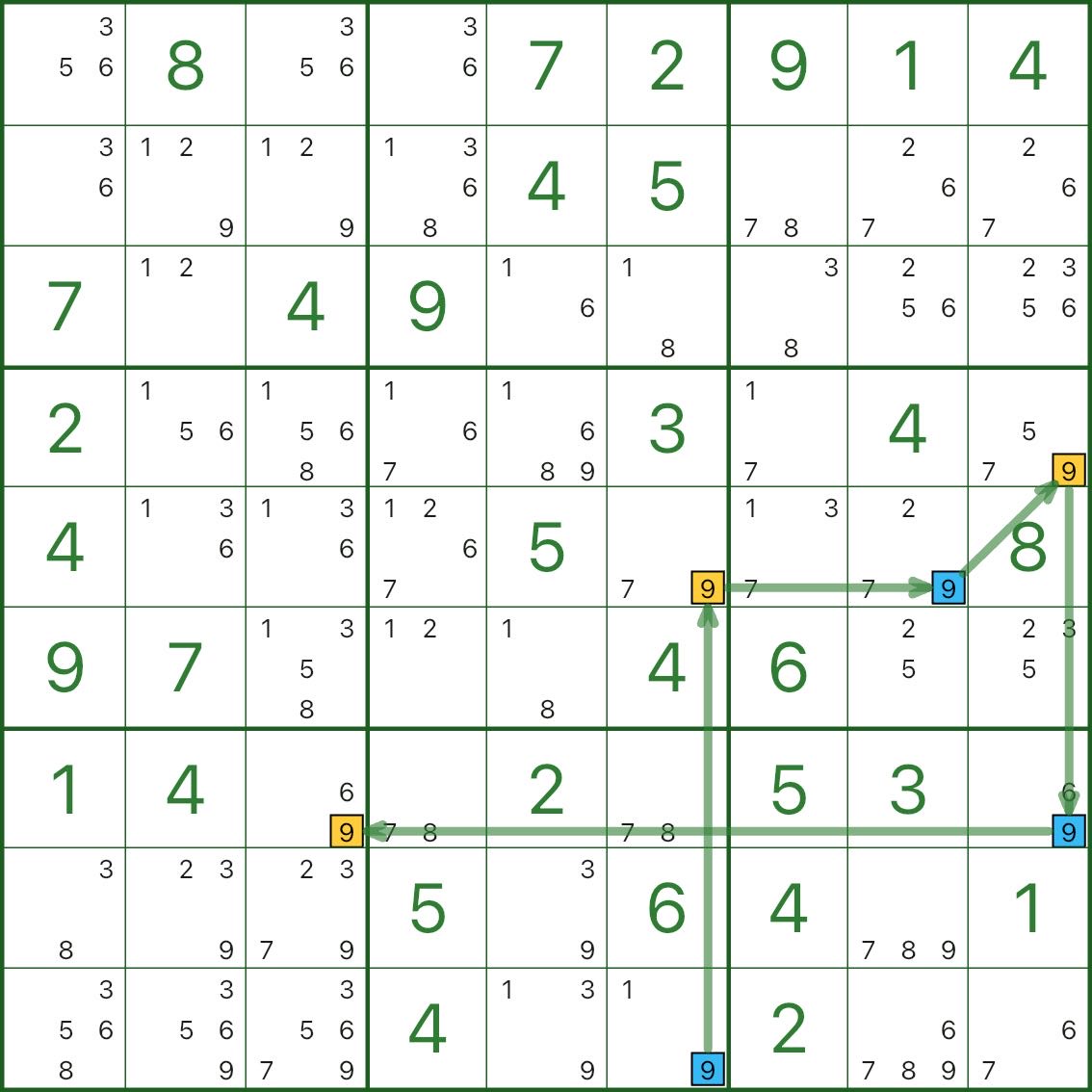
In image 1, the target digit is 9. We color a strong-link chain starting from r9c6; the other endpoint is r7c3 (blue/yellow).
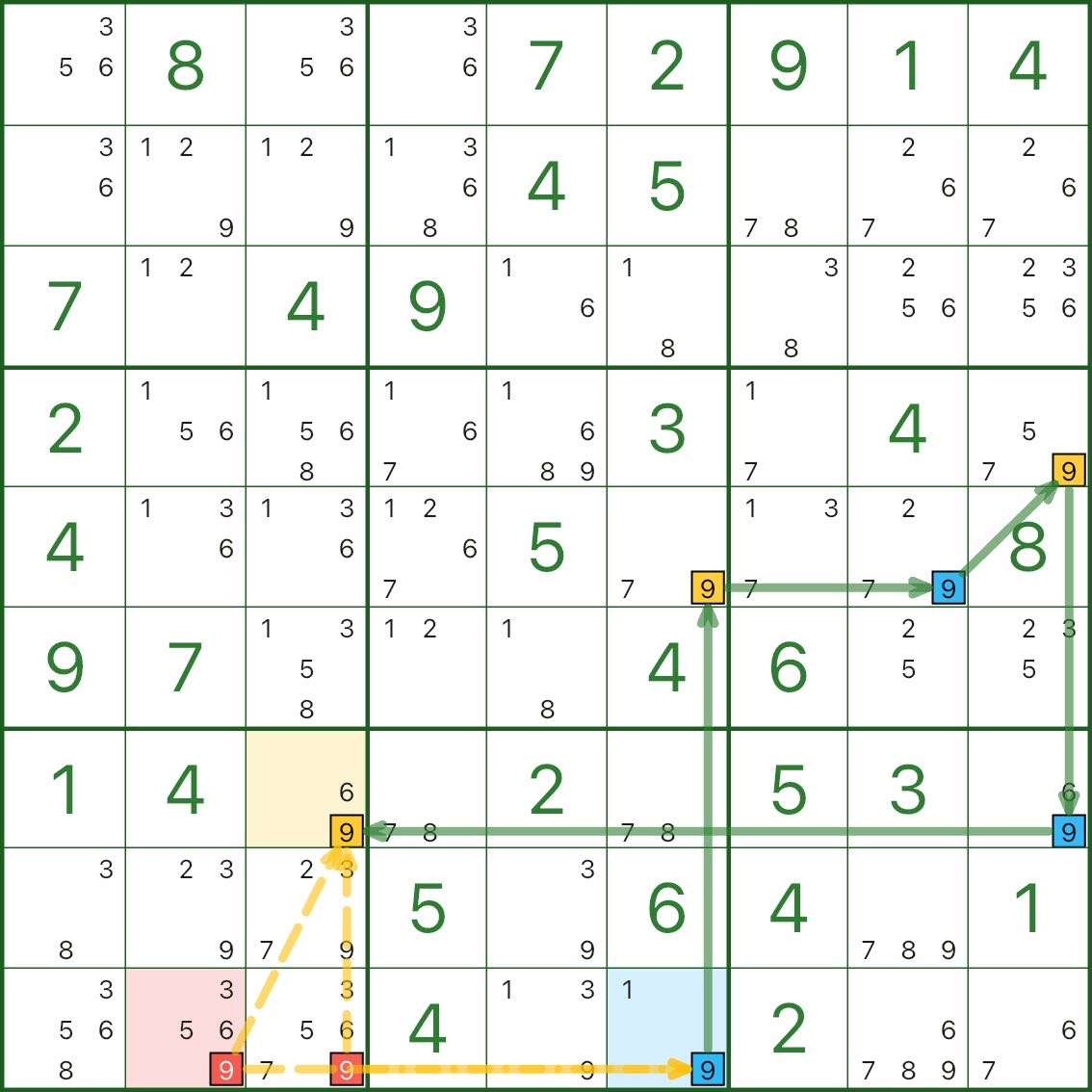
In image 2, the red candidates are candidate 9 in r9c2 and candidate 9 in r9c3.
Why can we remove them? The key idea is:
- If blue is true, the blue endpoint (for example r9c6) is 9. Since the red candidates can see it, they conflict with the blue endpoint and cannot be 9.
- If blue is false, then on the same strong link the yellow endpoint must be true (for example r7c3 is 9). The red candidates can also see it, so they still conflict and cannot be 9.
Either way, the red candidates cannot be 9, so they can be eliminated.
Same-color contradiction
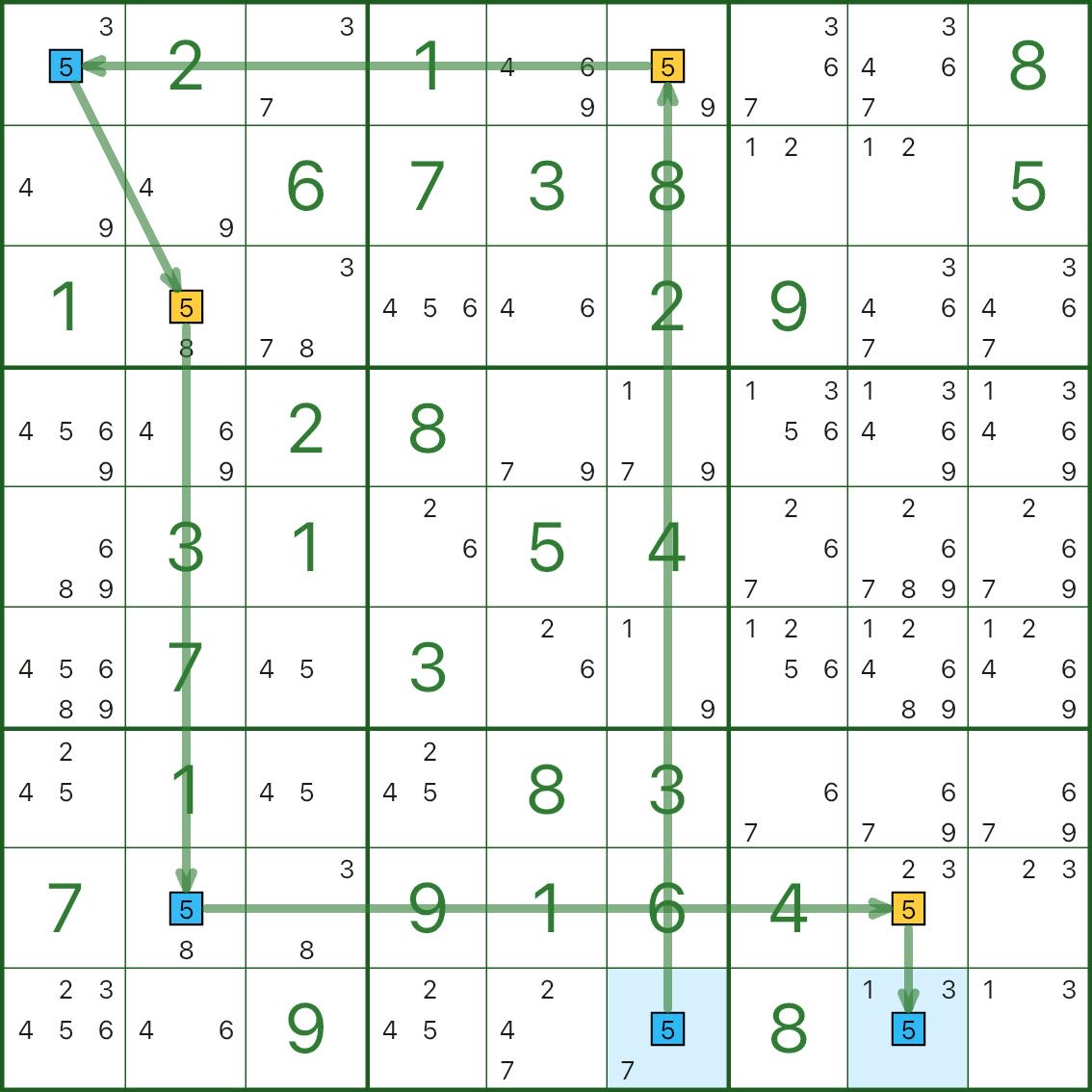
In image 3, the target digit is 5. Starting from r9c6, the chain eventually forces r9c8 to also be a blue 5.
But r9c6 and r9c8 are in the same row, so they can’t both be 5 — that’s a same-color contradiction.
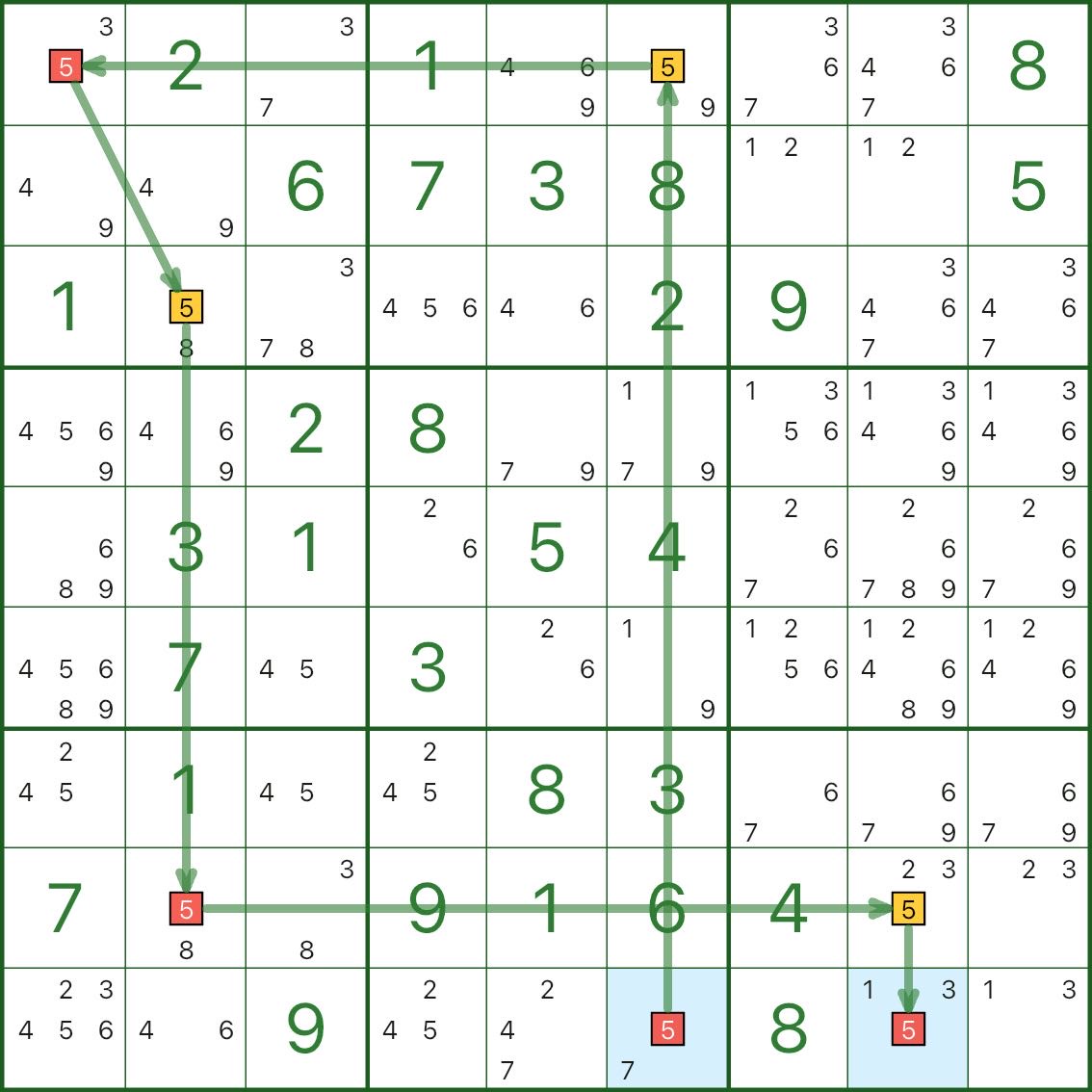
Therefore the blue route is impossible:
all blue candidate 5s can be eliminated (shown in image 4).
How to Find Basic Coloring
One-line checklist: find bilocation strong links, color them blue/yellow, then look for traps or same-color contradictions.
In a real puzzle:
- Pick a digit d
- Find bilocation strong links for d (a unit with exactly 2 candidates of d)
- Start anywhere and alternate colors along strong links
- Look for:
- a red candidate that sees one blue and one yellow → trap elimination
- two same-color candidates in one unit → eliminate that entire color