
Tips / BUG+1
Advanced
BUG+1
Prerequisite: BUG+1 relies on the puzzle having exactly one solution.
If you haven’t read it yet, start here:
Uniqueness
1. Overview
BUG+1 is short for BUG + 1 — you may also hear it called Bivalue Universal Grave + 1.
The name sounds scary, but it describes a very specific board state:
- almost every unsolved cell is bivalue (exactly 2 candidates)
- one “exception cell” has 3 candidates (that’s the “+1”)
What is BUG?
BUG = Bivalue Universal Grave.
It’s called a “grave” because the grid can feel “stuck”: candidates come in pairs everywhere, and progress often stalls without uniqueness.
When the grid satisfies these two conditions, it becomes a very symmetric “BUG” structure:
- every unsolved cell is bivalue
- for any digit d, in every house (row/column/box), the number of candidate positions for d is even
- most commonly 2
- if d is already placed in that house, it can be 0 (still even)
This symmetry often allows two valid completions (multiple solutions).
So what is BUG+1?
BUG+1 is “almost a BUG, but not quite”:
- all unsolved cells are bivalue
except one cell with 3 candidates
That extra candidate breaks the even symmetry — and that’s exactly what lets us force a placement using uniqueness.
So the exception cell has one forced candidate — we can place the digit directly.
2. Walkthrough
Step 1: spot the “almost all bivalue” state (top image)
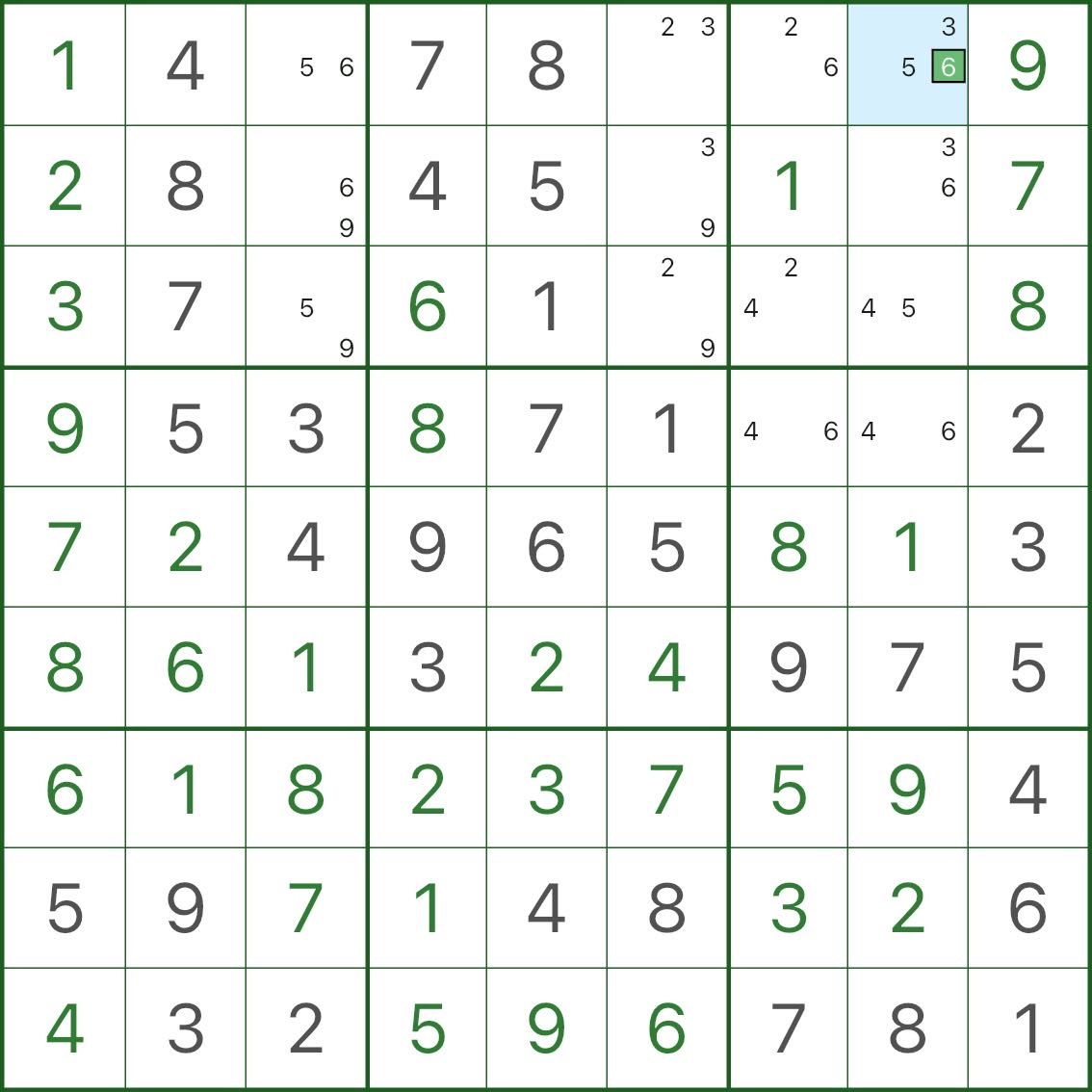
In the image:
- most empty cells show only 2 small candidates
- one cell is the exception, showing 3 candidates (the “+1”)
Step 2: which digit should we place? (and why?)
We only focus on the three candidates in the exception cell, and we do one simple thing: check odd vs even.
How:
- look at the three candidates in the exception cell
- for each of those digits, count how many times it appears as a candidate in the exception cell’s row / column / box
You will typically find that one digit appears 3 times (odd) in one of those houses.
That “odd” candidate is the digit you should place.
Why? Use a contradiction:
Assume we do not place this “odd” candidate, and instead pick one of the other two “even” candidates:
- the exception cell becomes bivalue
- the candidate distribution across houses returns to an “even” symmetry (a BUG structure)
- BUG structures often allow two valid completions (multiple solutions)
But the puzzle must be unique, so that choice is impossible.
Therefore the “odd” candidate must be true — that is the digit you place.
If you don’t want to count anything: the hint will highlight the forced candidate for you.
3. Example
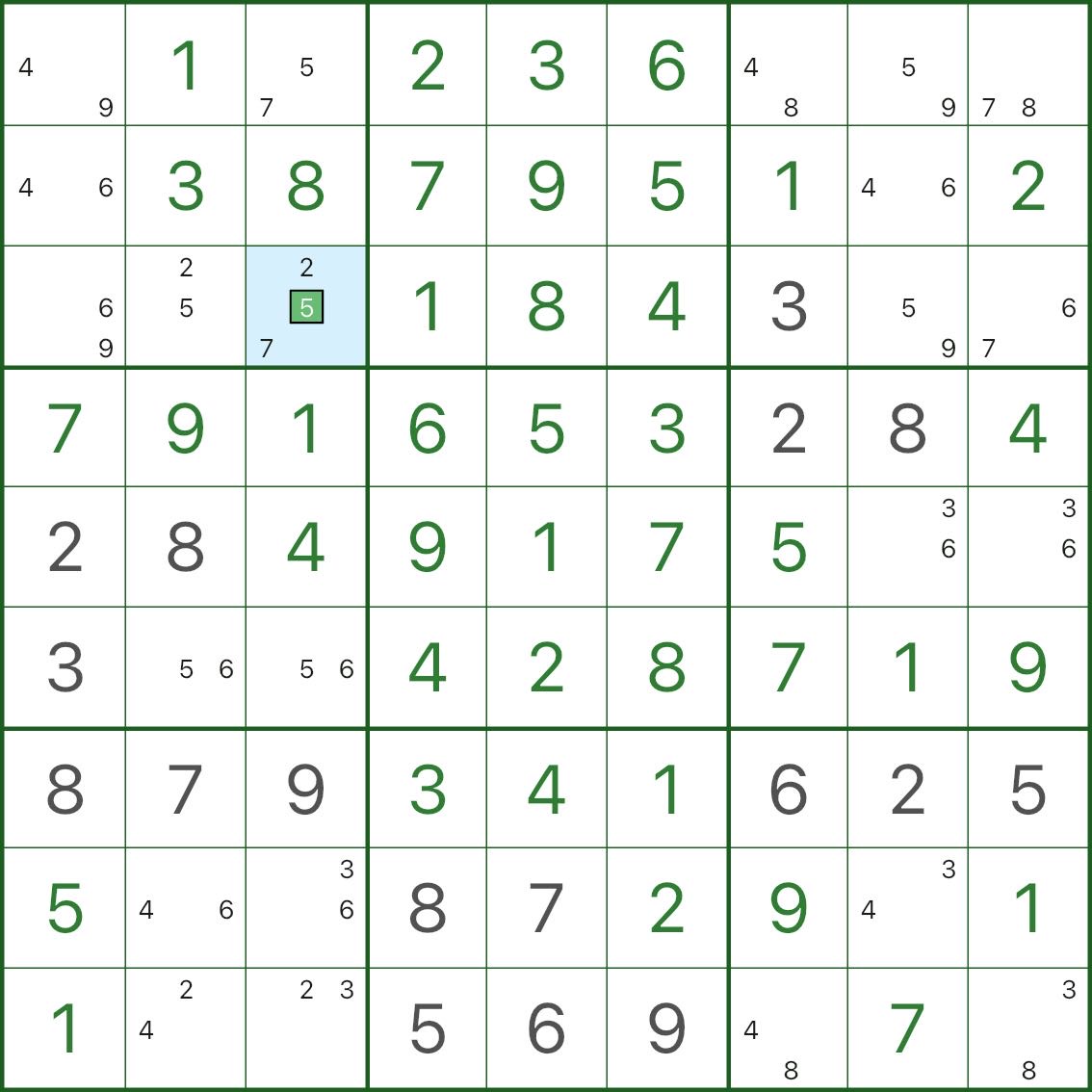
The image below shows the result: the forced “+1” candidate in the exception cell is placed.
4. How to spot BUG+1
Use this checklist:
- Make sure your candidate notes are complete and reliable (generate full candidates if needed)
- Look for a grid where:
- all unsolved cells are bivalue
- exactly one cell has 3 candidates
- In that cell’s row/column/box, count candidate occurrences for those three digits: the odd one (typically 3) is the forced digit
- The hint will highlight the exception cell and show which candidate is forced
Note: BUG+1 is a uniqueness-based technique — it only applies when the puzzle is guaranteed to have a single solution.