
Tips / Direct exclusion
Direct exclusion
Direct exclusion is the most reliable kind of Sudoku reasoning:
pick a digit, then in a row / column / box, find the only place it can go.
As long as you can explain:
“Every other spot would conflict”
then you’ve got a sure move.
In this guide we use r2c5 to refer to a cell:
r = row, c = column.
Example 1: Column exclusion (placing 8 in column 5)
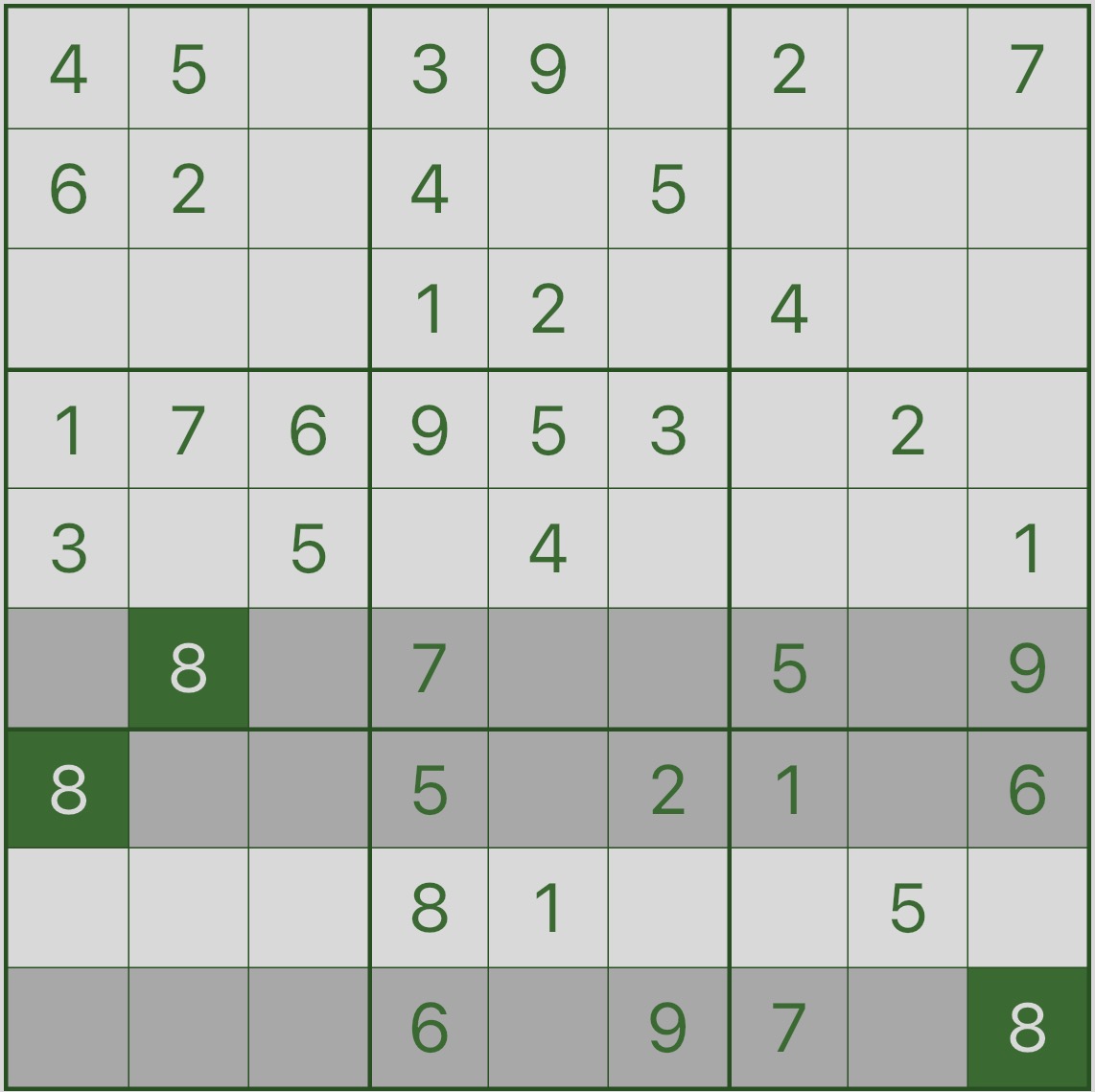
Look at Image 1 and focus on the highlighted area and the highlighted 8.
You’ll notice those highlighted rows already contain an 8.
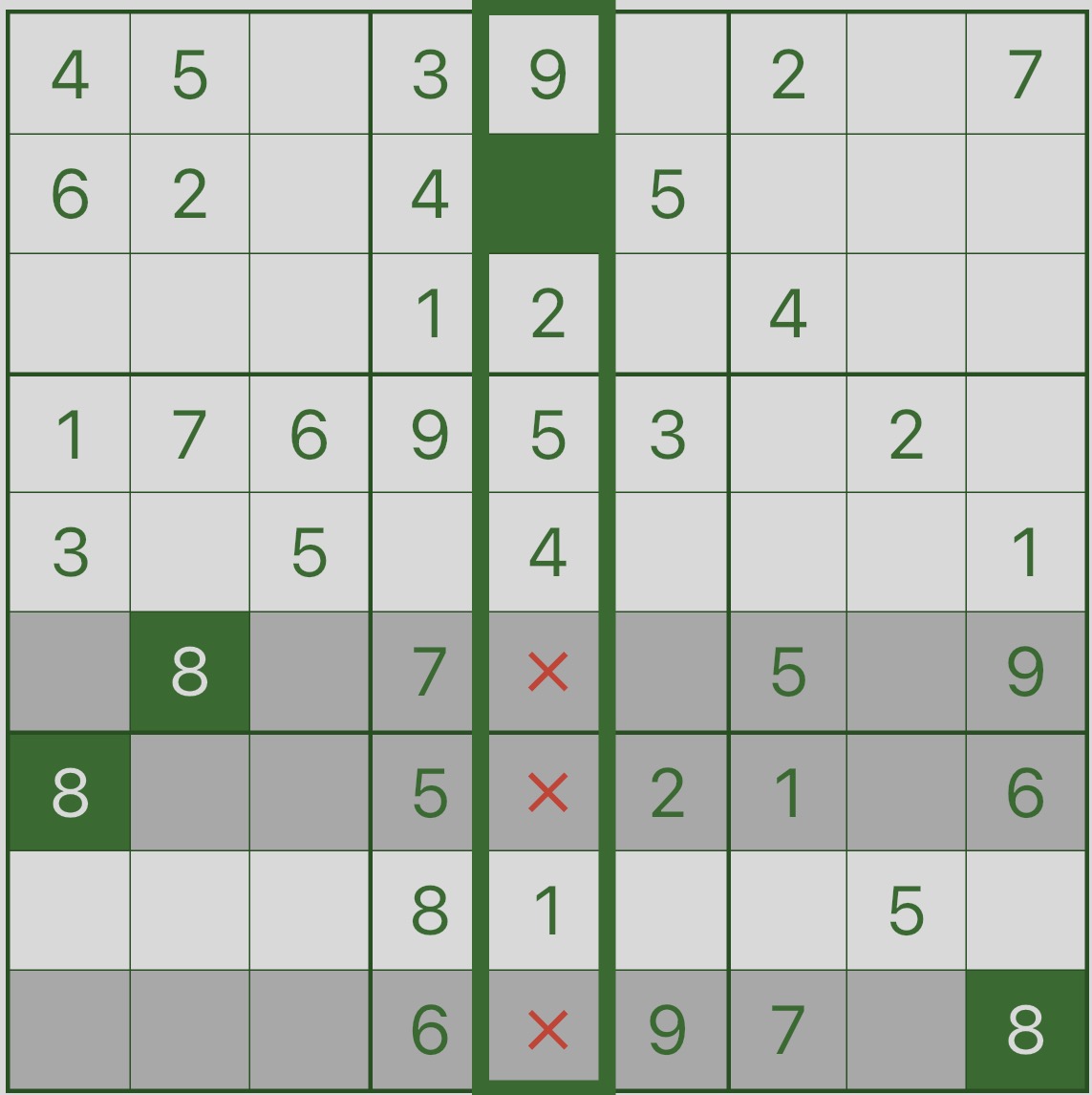
Now look at Image 2. We only care about column 5.
There are a few empty cells in this column, but their rows already have an 8 — so they can’t be 8:
- r6c5 is in a row that already has an 8 → r6c5 can’t be 8
- r7c5 is in a row that already has an 8 → r7c5 can’t be 8
- r9c5 is in a row that already has an 8 → r9c5 can’t be 8
That leaves only r2c5 as a valid spot for 8 in column 5.
So we can place: r2c5 = 8.
Example 2: Box exclusion (placing 1 in box 1)
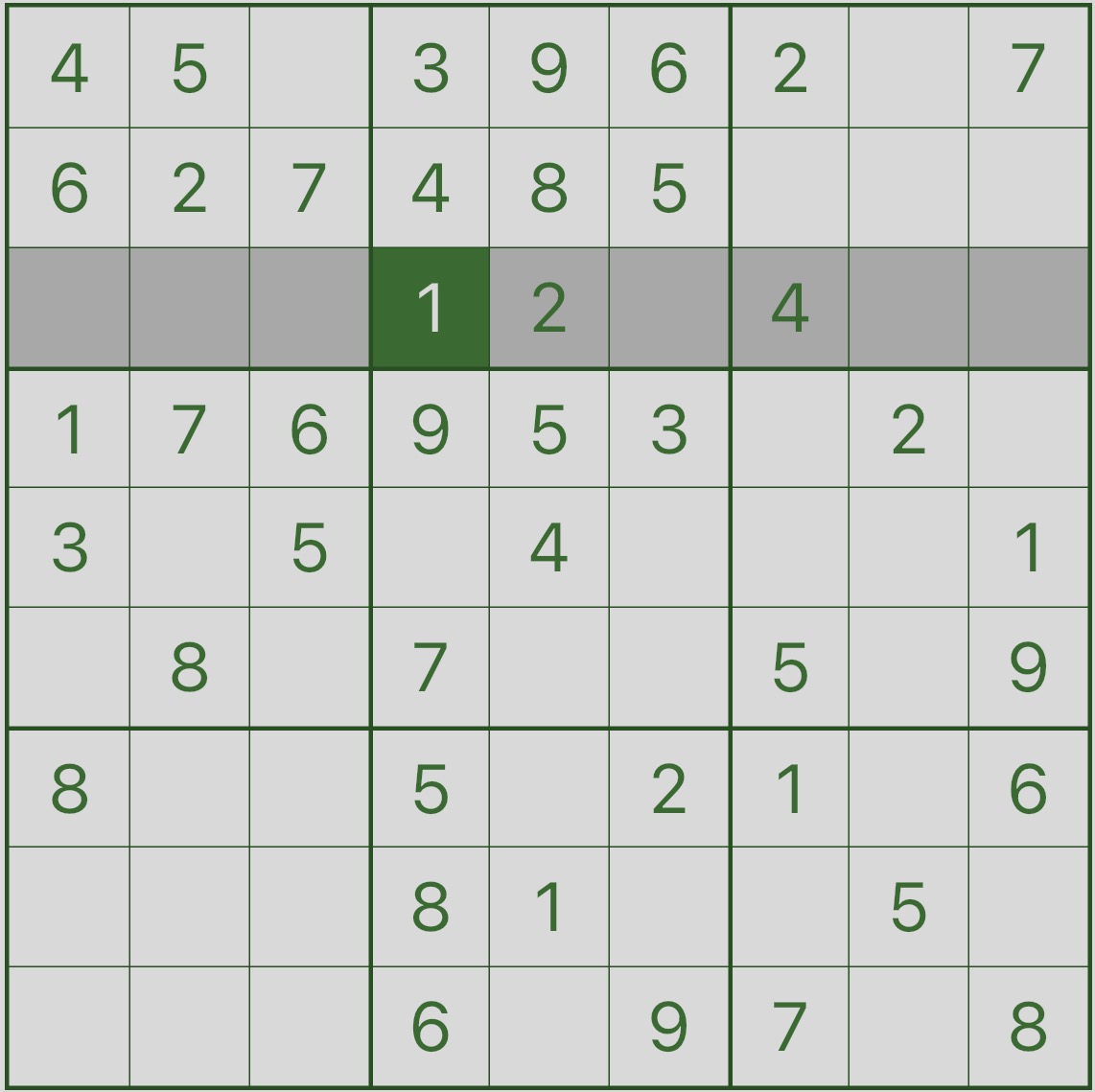
Look at Image 3 and notice the highlighted 1.
This tells us row 3 already contains a 1.
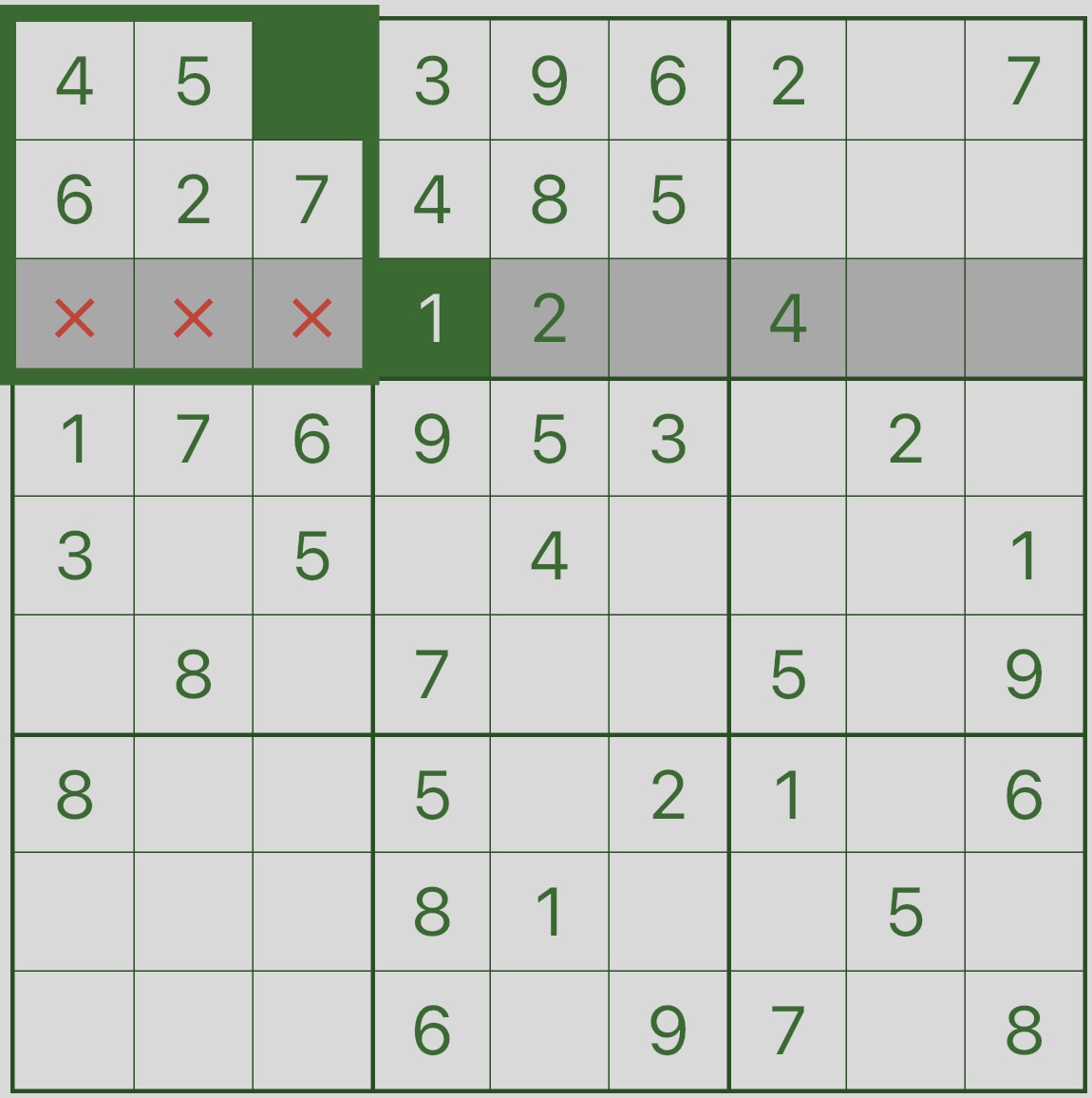
Now look at Image 4 and focus on box 1 (the top-left 3×3 box).
The three bottom cells of this box (r3c1, r3c2, r3c3) are all in row 3, and row 3 already has a 1 — so none of them can be 1.
So the only remaining place for 1 in this box is r1c3.
Therefore: r1c3 = 1.
Takeaway
Think of direct exclusion as:
“Pick a digit, rule out all conflicts, and the last remaining spot is the answer.”