
Tips / AIC (Standard Chain)
Master
AIC (Standard Chain)
Prerequisite: Chain basics
1. Overview
AIC (Alternating Inference Chain) is the “most general” kind of chain:
- it can mix the building blocks of X-Chain (single-digit strong links in a row/column/box) and XY-Chain (either-or inside a bivalue cell)
- as long as the chain keeps alternating strong / weak, the inference can propagate
Its most common use is elimination:
if an AIC implies the two endpoints cannot both be false, then any candidate that would make both endpoints false cannot be true — so it can be eliminated.
2. Walkthrough
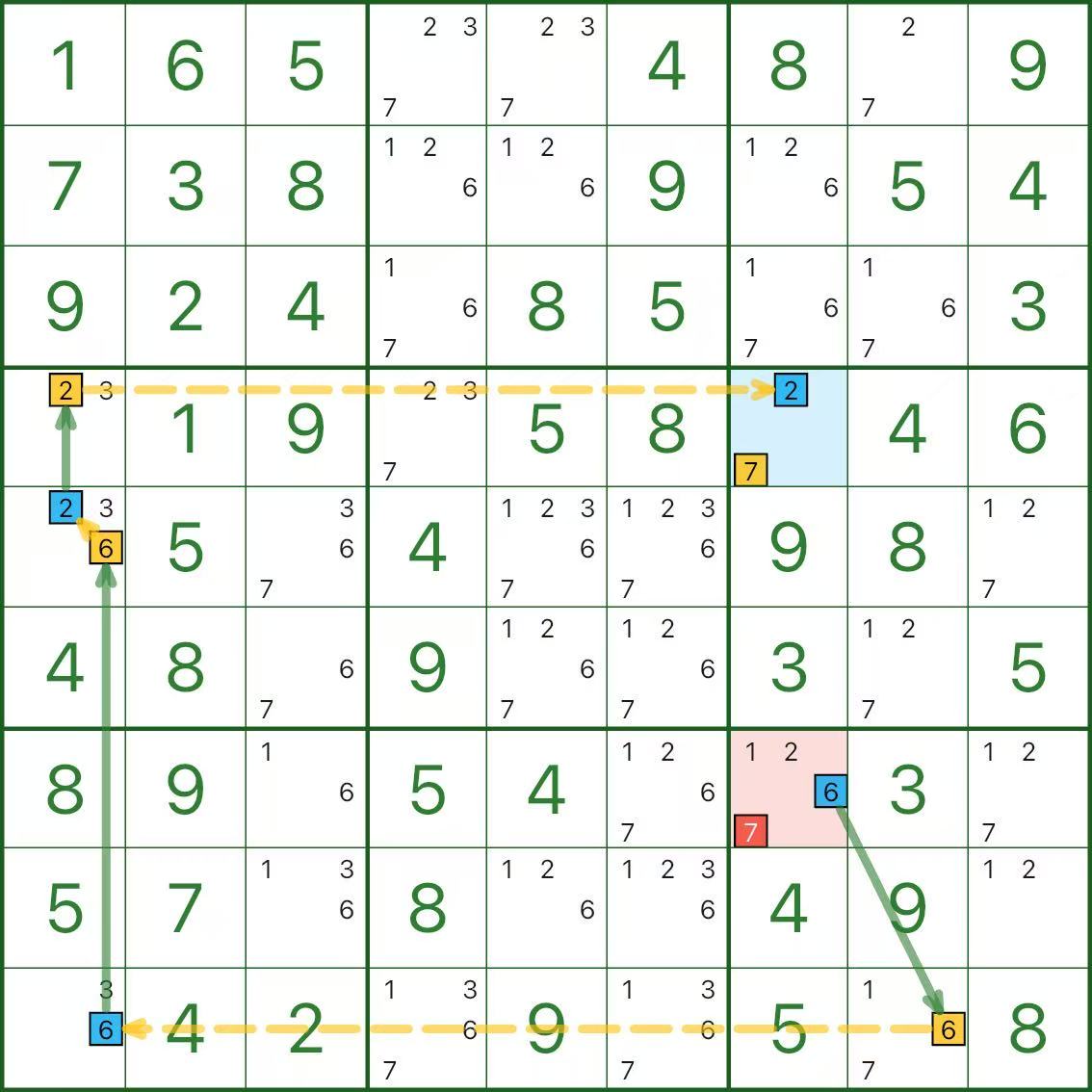
In the image:
- the two endpoints are candidate 6 in r7c7 and candidate 7 in r4c7 (blue)
- the elimination is candidate 7 in r7c7 (red)
- because r7c7 is both an endpoint and an elimination cell, we highlight it with the red background
Why can we eliminate 7 in r7c7? A short contradiction is enough:
Key fact: in an alternating strong/weak chain, if one endpoint is false, the inference propagates and eventually forces the other endpoint true.
So the two endpoints cannot both be false (at least one must be true).Now assume the red candidate r7c7 = 7 is true:
- same cell ⇒ candidate 6 in r7c7 is false
- same column ⇒ candidate 7 in r4c7 is false
This makes both endpoints false, which contradicts step 1.
So the assumption is impossible: candidate 7 in r7c7 can be eliminated.
3. Examples
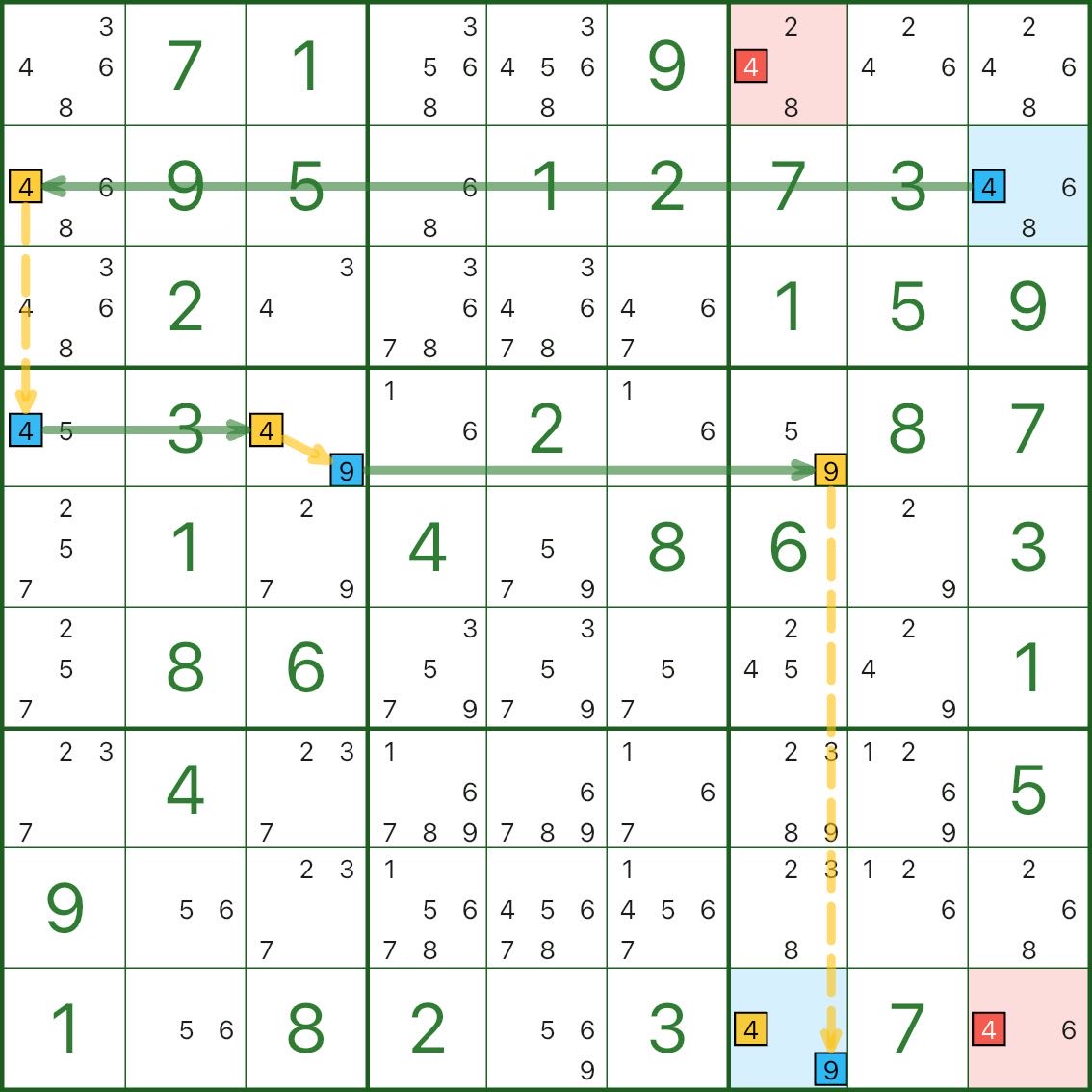
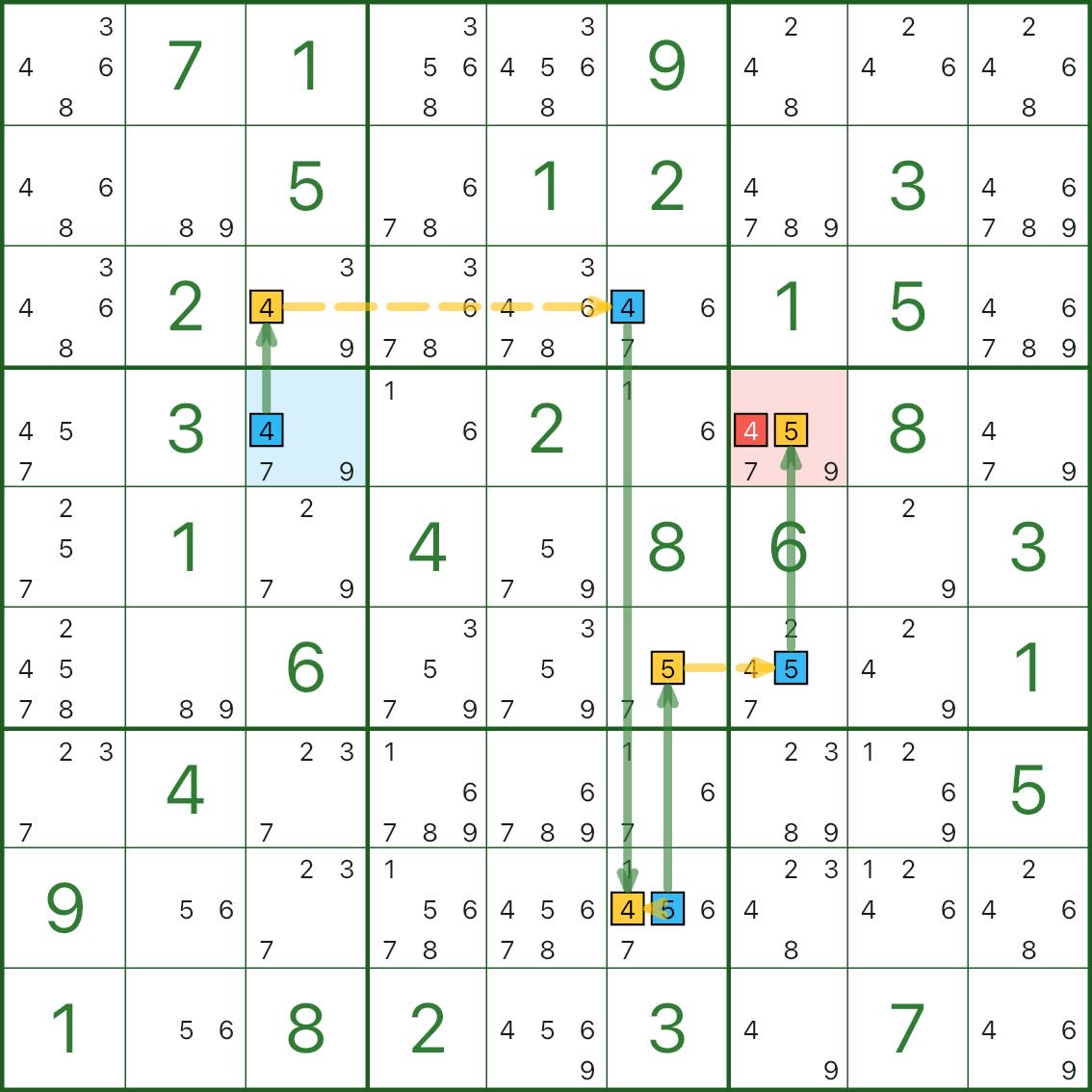
Here are two more AIC examples. Try to spot the pattern first:
- blue endpoints
- alternating strong/weak links
- a red candidate that conflicts with both endpoints
4. How to spot AIC
In one sentence: connect strong-link segments and bivalue segments into an alternating chain, then look for a candidate that would force both endpoints false.
Practical checklist:
- Find strong-link sources (green solid lines):
- a digit has exactly two candidates in a row/column/box (conjugate pair)
- or a bivalue cell gives an “either X or Y” strong link inside the cell
- Connect them with weak links (yellow dashed lines):
- same-digit conflicts (same row/column/box)
- different digits in the same cell
- Keep the strong/weak alternating pattern
- Look for a red elimination: a candidate that conflicts with both endpoints